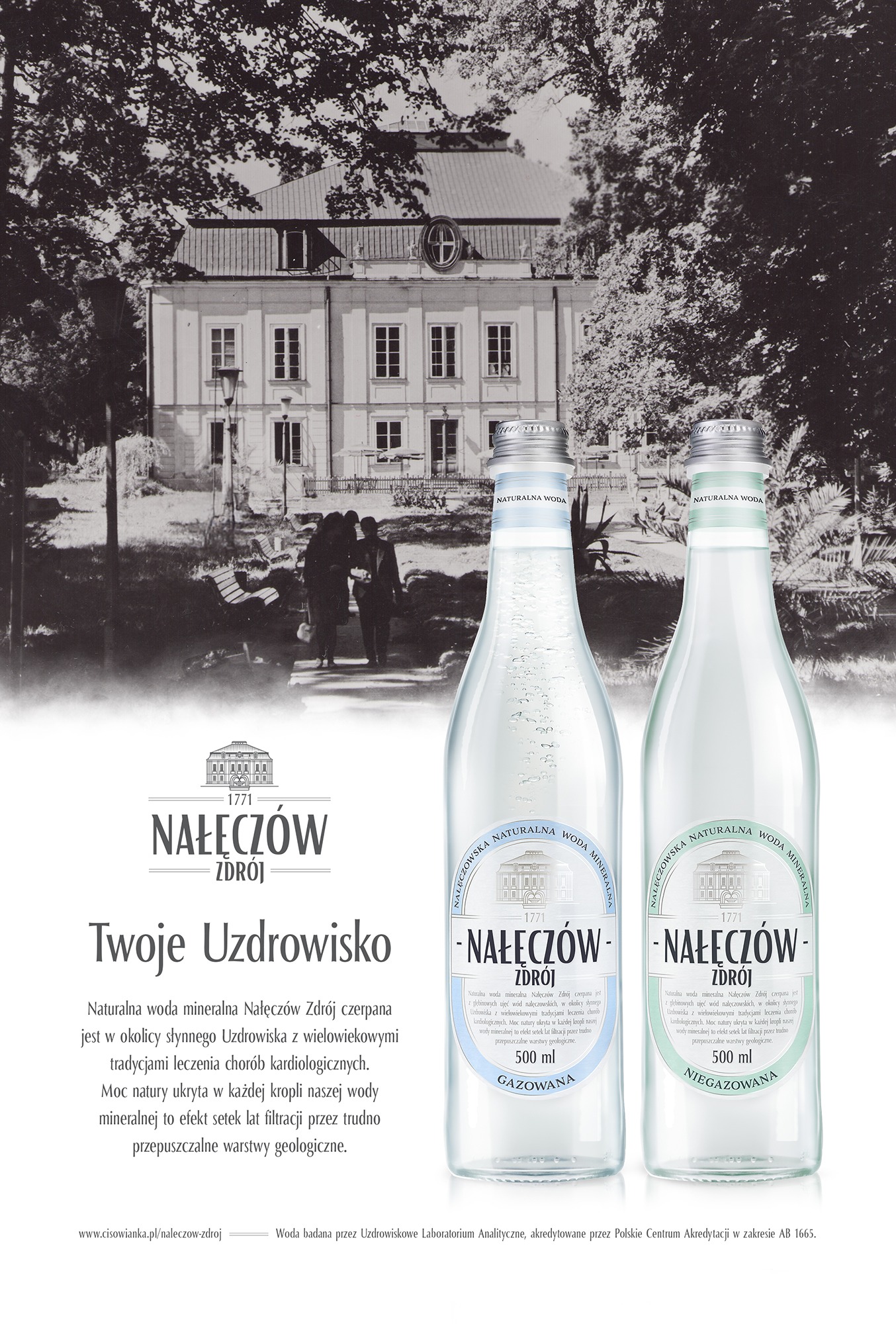

NAŁĘCZÓW ZDRÓJ
“Nałęczów has mineral waters that can be as effective as foreign waters; its waters can certainly be used throughout the summer.”
Józef Celiński, Analysis of the Mineral Waters of Nałęczów, 1817
“Nałęczów has mineral waters that can be as effective as foreign waters; its waters can certainly be used throughout the summer.”
Józef Celiński, Analysis of the Mineral Waters of Nałęczów, 1817

Today, more than 200 years later, Nałęczów Zdrój water still comes from the same deep underground sources — untouched, filtered for hundreds of years through low-permeability geological strata. The composition that Celiński described with his pen in 1817 is something you can hold in your hand today.
Today, more than 200 years later, Nałęczów Zdrój water still comes from the same deep underground sources — untouched, filtered for hundreds of years through low-permeability geological strata. The composition that Celiński described with his pen in 1817 is something you can hold in your hand today.
THE NAŁĘCZÓW SPRINGS
The Nałęczów springs were known and valued long before the world heard of Western Europe’s famous spas. In 1817, Dr Józef Celiński — one of Poland’s first chemists to study mineral waters — scientifically demonstrated what local people had known for generations: water from the Nałęczów springs matched the quality of the most famous foreign waters, and its properties were exceptional and inimitable.


HUNDREDS OF YEARS OF FILTRATION
In 1817, Józef Celiński published Analysis of the Mineral Waters of Nałęczów — Poland’s first scientific description of the composition of mineral water. His analysis identified calcium carbonate, iron oxide, silica and an alkaline salt.
Celiński compared Nałęczów water with Europe’s most renowned iron-rich waters — Reinerz, Altwasser and Flinsberg — and found that, when heated to bathing temperature, the foreign waters lost their excess carbonic acid and ceased to act, unlike Nałęczów water. In other words, what patients sought abroad could be found in Poland. In Nałęczów.
Today, more than 200 years later, Nałęczów Zdrój water still comes from the same deep sources — untouched, filtered for hundreds of years through low-permeability geological strata. The composition that Celiński described in 1817 is something you can hold in your hand today.
YOUR SPA
Celiński wrote about Nałęczów with clear admiration — not only as a scientist but also as someone sensitive to the beauty of the place. He described hills coloured by different shrubs, the picturesque setting of the valley and a mild summer without the fog and dampness typical of foreign mountain resorts. A spa which, he emphasised, nature had endowed with both therapeutic water and an exceptional landscape.
That landscape endures. The hills around Nałęczów look much as they did two hundred years ago. And the water — patiently filtered through the geology of the Lublin region — still emerges from the depths as pure, transparent and free of “muddy odours” as Celiński recorded in his historical work.

“Knowing the composition of these waters may keep us from seeking relief for our ailments abroad when we can find it in our own country.”
Józef Celiński, Analysis of the Mineral Waters of Nałęczów, 1817
“Knowing the composition of these waters may keep us from seeking relief for our ailments abroad when we can find it in our own country.”
Józef Celiński, Analysis of the Mineral Waters of Nałęczów, 1817